
Cylindrical roller bearings are available in a variety of designs, series and sizes. The rollers of cylindrical roller bearings are key components. Their geometry, the so-called logarithmic profile, provides an optimum stress distribution in the contact zones in the bearing. Their surface finish maximizes lubricant film formation and optimizes rolling motion of the rollers. The benefits derived from this compared with traditional designs include enhanced operational reliability and a greater insensitivity to misalignment.
The range of cylindrical roller bearings comprises the basic types.
>>single row cylindrical roller bearings, caged, mainly of the NU, NJ, NUP and N designs.
>>double row cylindrical roller bearings, caged, mainly of the NNUand NN designs.
>>single row full complement cylindrical roller bearings, mainly of the NCF and NJG designs.
>>double row full complement cylindrical roller bearings, mainly of the NNF design.
Cylindrical roller bearings with a cage can accommodate heavy radial loads and operate at high speeds. Full complement cylindrical roller bearings are suitable for very heavy radial loads at moderate speeds.
Cylindrical roller bearings has a high carrying capacity, was widely used in agricultural machinery, large and medium-sized motors, rolling stock equipment, machine tool spindle, internal combustion engine, generator, gas turbine, gear box, rolling mill machine, vibrating screen and lifting machinery etc.
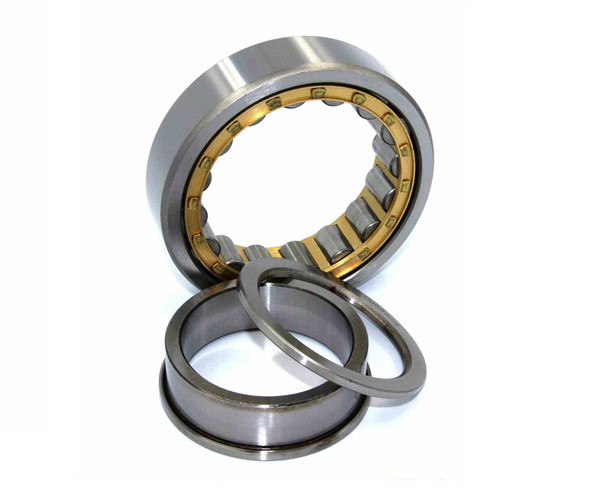
In a single row cylindrical roller bearing, the rollers are always guided between the integral “open” flanges on one of the rings. These “open” flanges combined with the specially designed and surface finished roller ends, provide improved lubrication, reduced friction and consequently lower operating temperature.
The ring with the integral flanges together with the cylindrical roller and cage assembly can be separated from the other ring. This results in easy mounting and dismounting, particularly where the load conditions are such that interference fits are required for both rings.
Our single row cylindrical roller bearings can accommodate heavy radial loads and high speeds. They are manufactured in several different designs, the main difference being in the configuration of the flanges.
Design da NU
O anel externo de um rolamento do tipo NU possui duas flanges integradas, enquanto o anel interno não possui flanges (a). O deslocamento axial do eixo em relação ao alojamento pode ser compensado em ambas as direções.
Design N
O anel interno de um rolamento do tipo N possui duas abas integradas, enquanto o anel externo não possui abas (b). O deslocamento axial do eixo em relação ao alojamento pode ser compensado em ambas as direções.
Design de NJ
O anel externo de um rolamento do tipo NJ possui duas flanges integradas, enquanto o anel interno possui uma flange integrada (c). Esses rolamentos permitem a fixação axial do eixo em uma direção.
Design da NUP
O anel externo de um rolamento do tipo NUP possui duas flanges integradas, enquanto o anel interno possui uma flange integrada e uma flange não integrada na forma de um anel de flange solto (d). Esses rolamentos podem ser utilizados como rolamentos de fixação para fixar o eixo axialmente em ambas as direções.
Execução da NU+HJ
An NU –type bearing combined with an HJ angle ring (e) can be used to locate the shaft axially in one direction. SKF recommends not to fit standard angle rings at both sides of an NU-type bearing as this can lead to axial compression of the rollers.
Execução de NJ+HJ
Um rolamento do tipo NJ, combinado com um anel angular HJ (f), pode ser utilizado para fixar o eixo axialmente em ambas as direções.
Design da RNU
Rolamento de rolos cilíndricos NU-design sem anel interno
Design RN
Rolamentos do tipo N sem anel externo
 PT
PT  EN
EN  ES
ES  RU
RU